Bel Canto
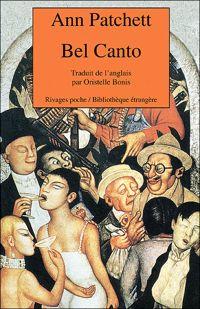
Bel Canto
(2002)
427 pages
Quelque part en Amérique du Sud, une somptueuse réception donnée en l’honneur d’un puissant industriel japonais réunit des hôtes de marque autour de la célèbre cantatrice américaine Roxane Coss. Alors que s’égrènent les dernières notes du récital de la diva, une bande de guérilleros armés jusqu’aux dents investit les lieux et prend les invités en otage. Le président du pays ayant fait savoir qu’il refusait de se rendre à la guérilla, la prise d’otages est partie pour durer. Au fil des semaines, puis des mois, des rapports singuliers se tissent entre les prisonniers et les guérilleros à mesure que s’instaure un fragile modus vivendi. Avec une remarquable virtuosité, Ann Patchett met en scène des personnages d’horizons très différents, séparés par la barrière de la langue et de la culture, et transforme ce huis clos en une fenêtre ouverte sur le monde. In an unnamed South American country, a world-renowned soprano sings at a birthday party in honor of a visiting Japanese industrial titan. His hosts hope that Mr. Hosokawa can be persuaded to build a factory in their Third World backwater. Alas, in the opening sequence, just as the accompanist kisses the soprano, a ragtag band of 18 terrorists enters the vice-presidential mansion through the air conditioning ducts. Their quarry is the president, who has unfortunately stayed home to watch a favorite soap opera. And thus, from the beginning, things go awry. Among the hostages are not only Hosokawa and Roxane Coss, the American soprano, but an assortment of Russian, Italian, and French diplomatic types. Reuben Iglesias, the diminutive and gracious vice president, quickly gets sideways of the kidnappers, who have no interest in him whatsoever. Meanwhile, a Swiss Red Cross negotiator named Joachim Messner is roped into service while vacationing. He comes and goes, wrangling over terms and demands, and the days stretch into weeks, the weeks into months. With the omniscience of magic realism, Ann Patchett flits in and out of the hearts and psyches of hostage and terrorist alike, and in doing so reveals a profound, shared humanity. Her voice is suitably lyrical, melodic, full of warmth and compassion. Hearing opera sung live for the first time, a young priest reflects: Never had he thought, never once, that such a woman existed, one who stood so close to God that God's own voice poured from her. How far she must have gone inside herself to call up that voice. It was as if the voice came from the center part of the earth and by the sheer effort and diligence of her will she had pulled it up through the dirt and rock and through the floorboards of the house, up into her feet, where it pulled through her, reaching, lifting, warmed by her, and then out of the white lily of her throat and straight to God in heaven. Joined by no common language except music, the 58 internat